The Player's the Thing

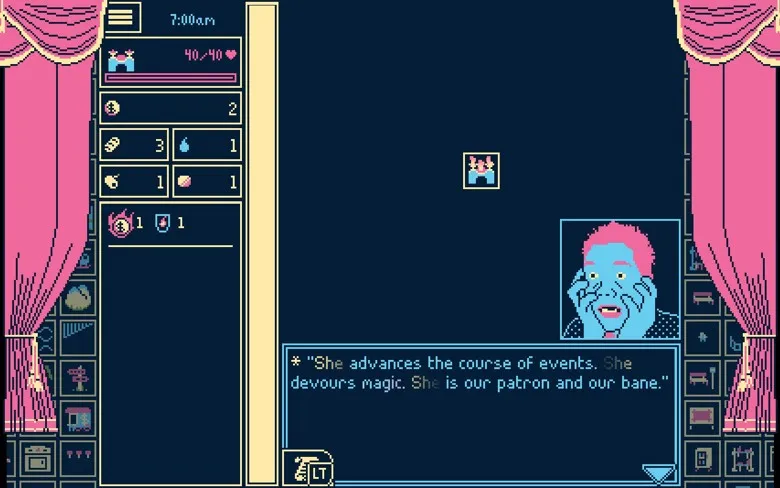
The absurdist world of faeries that you are thrust into when starting Titanium Court is a shock to the system. There is no attempt to make itself comprehensible to the player; the titular Court —and the lands around it— shift every day. Perhaps you will never make sense of the Court, perhaps there is only the cycle of war during the day and revelry at night. And then, amongst the ebbing tide, the Mirror appears. You gaze into it.
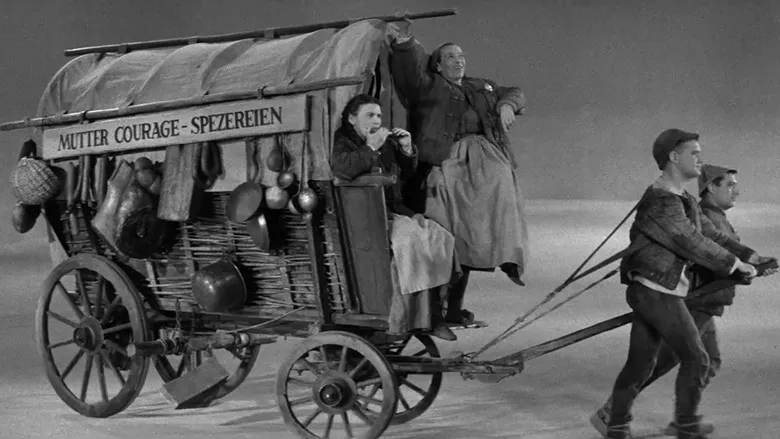
In his 1930 essay The Modern Theatre is the Epic Theatre, German playwright and practitioner Bertolt Brecht laid out a theatrical framework known as the ‘alienation’ effect, to counter the failings he saw in the Aristotelian model of theatre that centered around catharsis. Under the Aristotelian model, the audience is encouraged to identify so closely with the characters of a play that their struggles become the struggle of the audience. The audience vicariously lives through the rising action, climax, and falling action of a story as an outlet for emotion, making them complacent to the injustices they face in reality.
Brecht sought to instead distance the spectator from the action of the play, thus 'alienating' the audience through various means. Production choices such as bare staging and constantly keeping not just the stage but the entire theatre in bright lighting, remind the audience that they are viewing a fiction. Brecht embraced non-linear narrative structures and would unnaturally break the action with songs as a way to never allow the audience to lose themselves in the flow of a story. Rather than encourage identification with the characters Brecht hoped to "arouse [the audience's] capacity for action."
That action was Brecht's main goal behind Epic Theatre, and had revolutionary purpose: "When I read [Karl] Marx's Capital, I understood my plays." Defined by Marx, capitalism alienates the masses from their labor, society, and even their own humanity. By alienating audiences from the theatre, Brecht hoped to show them how this occurred in their daily lives, using Lehrstücke, or learning plays, with the express goal of educating the masses on socialist issues.
Due to his revolutionary theatre, Brecht fled Nazi Germany in 1933, landing eventually in the United States in 1941. In 1947 he testified before the House Un-American Activities Committee under suspicion of harboring communist sympathies. He fled the US the day after his testimony, continuing his theatrical work in East Germany until his death in 1956.
17 years later, Brazilian theatre practitioner and theorist Augusto Boal published his book Theatre of the Oppressed while in exile from his home country, building off of Brecht's work to investigate how audiences could have a more active role in the medium. Just as Brecht before him, Boal saw inherent flaws in the Aristotelian model of theatre –going so far as to call it a tool for intimidation— writing that the ruling classes have co-opted theatre and put up walls, the largest of which divides the actors and spectators. To counteract this, he established the idea of the Spect-Actor, where everyone is both at once. Audiences are brought into the work to propose alternative solutions to the problems of the play instead of remaining passive observers, a way for the masses to seize the proverbial means of theatrical production.
Yet Boal remained rooted in Brecht's belief that audiences must understand the purpose of the work. Thus, the character of a "Joker" acts as a facilitator of improvisation by jumping in and out of roles or stopping the action to prompt suggestions. The goal is not to lose oneself in a role, but to practice scenarios that could speak to real struggle. Boal called it a "rehearsal for revolution".
After the Brazilian coup d'etat of 1964, Boal's works were seen as so dangerous that in 1971 he was tortured, and then exiled. He would not return until the military dictatorship was toppled fourteen years later, after which he would continue to teach and practice his Theatre of the Oppressed until his death in 2009.
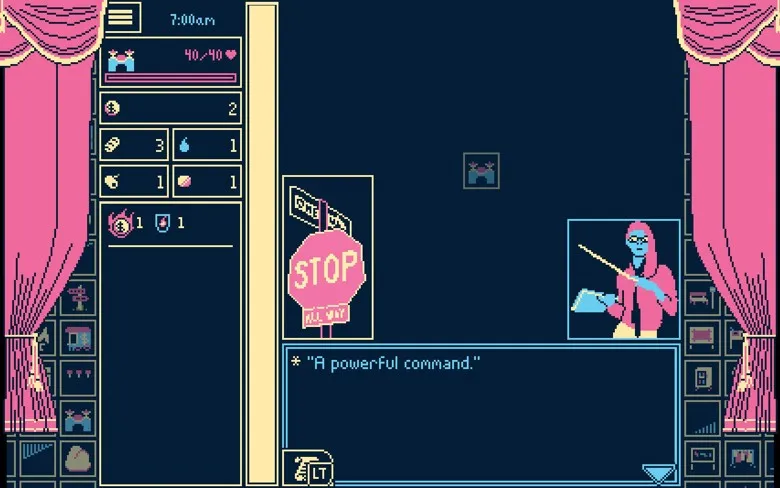
Titanium Court employs the theatrical ideas laid out by both Brecht and Boal from the moment it begins. We are greeted by a man on a stage (complete with red curtains pulled to the wings) informing us that this is a game, and this performance will star an understudy –which we quickly realize is ourselves– in the role of the 'Player'.
After this preamble, we enter the titular Court and meet its faerie inhabitants. This first interaction, however, remains and emphasizes the fundamental agreement of interactive mediums like video games and theatre; the actor-audience contract. Actors agree to tell a story and the audience agrees to accept this fiction and buy into the world the actors build. Even Brecht and Boal, who highlight the fiction of these performances, still rely on this agreement. Most video games also utilize it, but AP Thompson has made this usually unspoken agreement textual in Titanium Court.
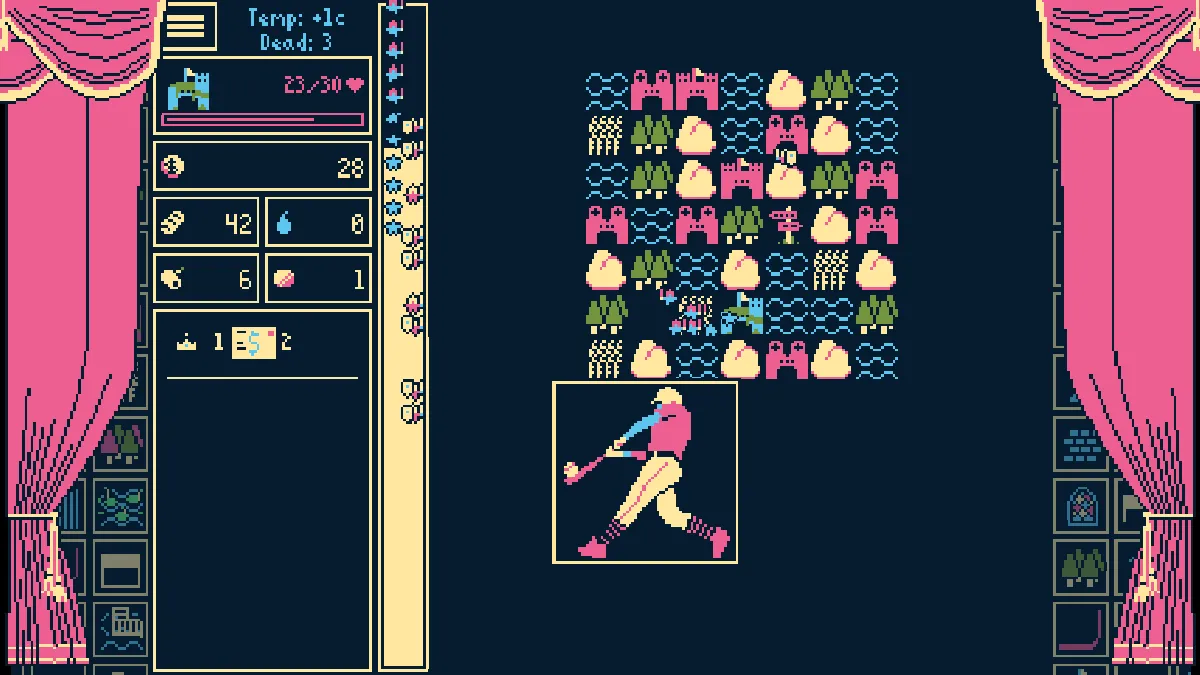
The game continues to invoke the framework of Brecht's Epic Theatre, constantly reminding players of the edges of the stage. The red curtains we see in the prologue remain on the side of the interface as a frame to the events in the Court, alluding to our role as a spectator separate from the action. Characters are also aware of their own performance, at least that is the case for Puck, who serves as our unwilling guide (and one of many overt references to Shakespeare's A Midsummer Night's Dream). When not actively engaging with the player, it is possible to find Puck lounging backstage in his dressing room; an actor taking a few minutes of relaxation before his next scene.
Titanium Court’s roguelite structure turns Brecht's love of montage into mechanical loop; the player does the same thing over and over again with minor variations. Our actions within the Court and during war are visualized with flashing symbols that disorient the player. The faeries unintelligibly analyze the signage of our reality as absurd anthropologists, likening cars to cryptids. By extension we are encouraged to make our own humanity the subject of inquiry. AP Thompson conjures Brecht again by allowing us to witness a musical interlude instead of boss battles, and while these songs don't necessarily speak to the events of the game they do intentionally break the action. All of these elements are intended to, and succeed at, alienating the player from the story of the game.
From Boal, Titanium Court takes the idea of the Spect-Actor. Just as Theatre of the Oppressed requires audience action to decide the flow of a performance, so too does Titanium Court. By controlling the Queen, we guide the Court and the lives of its inhabitants, not simply being told a story but taking part in it. To encourage this Puck takes on the role of the Joker, guiding us in this world and prompting our action, or inaction as he’d prefer. To this effect he also seemingly jumps in and out of roles, as there is evidence he may also be playing the part of Robin (another courtier).
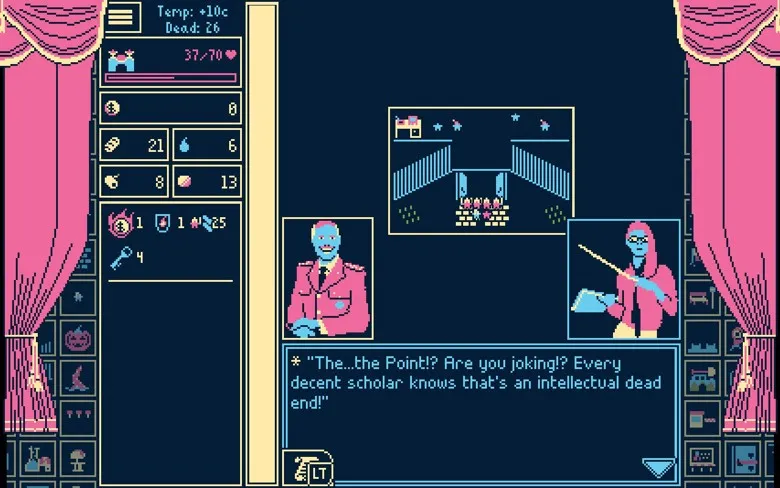
But to what end are these effects used? For Brecht and Boal, the desired culmination of their work was always revolution, enacting change. Titanium Court also claims that undergoing a real change is a requirement to leave the Court and return to your life. So what is ‘The Point’? This is when Titanium Court drops the other proverbial shoe, revealing that its use of theatrical frameworks is in service of something far less compelling than its influences.
Let us, finally, revisit the Mirror.
When you look into it the screen grows into a black void; becoming a mirror reflecting the player, and the game addresses us not in our role as the Queen of the Court, but as a player. The fourth wall break reveals a great "truth": The Court is a fiction. We learn that by playing this game we are devouring the magic of the world and, if we do not end the game at the earliest possible opportunity, the entirety of the Court's inhabitants will go ‘stale’, essentially becoming living statues. Puck has already referred to the "Other Queen" who constantly watches the actions of the Court. After the Mirror, we realize we are the Other Queen.
Titanium Court now breaks the foundational agreement we made with the game upon starting it. It already framed itself as a fiction which we all take part in together. It already highlights the artificiality of the world, withholding the audience from the illusion that this is anything but performance. By breaking the actor-audience contract, the player is put (unwillingly) in opposition to the story we believed we were being told. Didn't we acknowledge the fiction of the performance in the prologue?
Instead of an alienation effect that encourages the audience to reflect through the lens of the game, Titanium Court's metatextual turn only alienates the player. In doing so it fundamentally misunderstands the theatrical frameworks it replicates.
Brecht and Boal made the audience acknowledge the fictional nature of the performance, but it then sought to enlist the audience as collaborators and co-revolutionaries. Titanium Court can only see the player's role in art as something destructive. Our presence as a Spect-Actor in the narrative causes NPCs to stale, which the faeries view as a death-like state for the immortal, but is literally a state in which they reach the end of the dialogue AP Thompson has written for them. The only realization Titanium Court wishes to inspire within the player is that they are evil.
The failure of this thematic turn is that the broad judgment of its player base is not only boring, but deeply flawed. "The moral choices game pose and the psychological judgements they then subsequently pass on you are so extreme and hypothetical…that I find it hard to take them seriously even as metaphors," writes Ed Smith in 'It Doesn't Matter When You Kill All the Civilians,' "You know when you play a game that it isn’t real. You know the people who made it know absolutely nothing about you." Titanium Court also conveniently fails to implicate AP Thompson in this cycle of harm despite being the developer (and thus true architect of the Court's suffering). Thompson instead casts himself as nothing but a harmless guitar player who will sing for you. If Augusto Boal existed in the world of Titanium Court, his work would end in the faeries of the Court coming together to find and hang AP Thompson by the strings of his acoustic guitar.
If Titanium Court is a commentary on how gamers devour games as a product then it equally fails. Smith again, "When I choose to bomb all the civilians in Spec Ops: The Line, I’m doing it to advance the game and see what happens and how it’s going to affect the characters. It’s precisely the same to me as turning a page in a book. It has no moral aspect or essence. It’s a mechanical action." Titanium Court wants us to feel guilty for holding up our part of the agreement while it eschews its side: telling a story. In fact Titanium Court seems to not value the inherent worth of storytelling at all.
To return to the theatrical form, theatre and its practitioners have dealt with the existentialism of the medium for decades. What's worth noting is how the takeaway differs from Titanium Court. In Tom Stoppard's Rosencrantz and Guildenstern are Dead, the two titular characters grapple with the growing knowledge that their fate is sealed; it's in the title! Yet Stoppard still imbues the play with a sense of hope and purpose. Sure Rosencrantz and Guildenstern die, but this is also the only time they live. To not observe is to be in a fate worse than death (perhaps a true staling). As The Player tells Rosencrantz and Guildenstern, "You don't understand the humiliation of it. To be tricked out of the single assumption that makes our existence bearable – that someone is watching... We need an audience."
Observing the story does not destroy magic, it makes it. If our observation is enough to tumble the house of cards that is Titanium Court's world then that fault lies not in the supposed destructive nature of the player, but in AP Thompson as its builder. Titanium Court cannot believe in the power of its own medium; Perhaps it all seems a bit too similar to cars.
After learning the truth of the Mirror, Puck can be confronted about the fiction of the world and the need to escape. He will once again break the façade and tell the Other Queen that she has the means of escaping the Court at any time. JUST. TURN. IT. OFF.
Okay.