"Lesbian knight game" 1348 Ex Voto isn't all that interested in lesbians
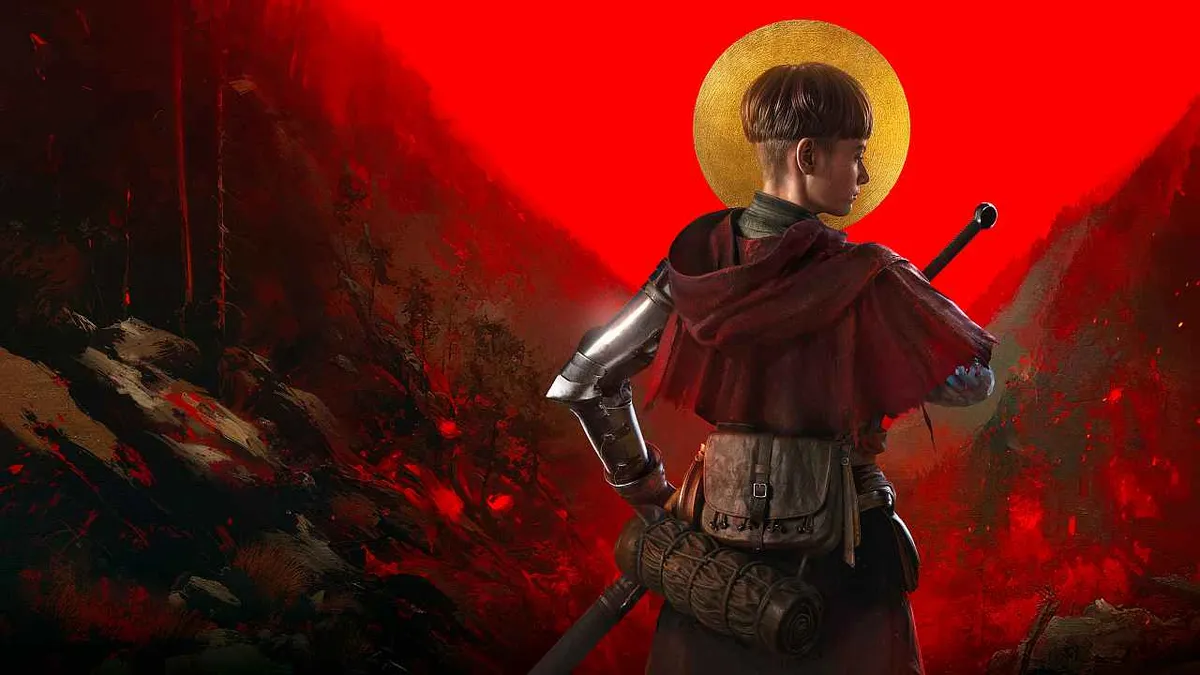
This piece contains spoilers for the entirety of 1348 Ex Voto.
You have been warned.
What is it about lesbians that makes us drawn to stories of doomed love? Maybe I should generalize less. What is it about me that makes me so drawn to stories of doomed queer love? Perhaps I find something inherently romantic about the intense emotions they elicit, the yearning, the idea that even if two people do love each other that the world can conspire to keep them apart no matter how hard they try. 1348 Ex Voto is a story of doomed love. Colloquially known as "the lesbian knight game" it courts a queer (especially lesbian) audience.
It tells the tale of Aeta (Alby Baldwin), a knight errant on a quest to rescue her beloved, the postulant Bianca (Jennifer English) from villainous kidnappers. Spoiler: It ends in tragedy. It is doomed not because the world conspires to keep them apart, but because the narrative itself is unable to truly engage with what Aeta and Bianca's queerness means in the world they exist in, instead choosing to devolve into a shallow story of betrayal. The biggest betrayal of 1348 Ex Voto, however, is not Bianca's betrayal of Aeta (or even vice versa) it is the game's betrayal of its two queer leads and, furthermore, the audience.
After (much like her Italian brethren Mario) hopping from location to location only to be told her princess is in another castle, Aeta eventually reaches the end of her journey. Pushing through the doors of a ruined building at the center of a town under siege, she is faced with the architect of her suffering. It is none other than, who else, Bianca herself. It's played as a climactic reveal but feels like an inevitable conclusion to a story more interested in dramatics than narrative cohesion.
In a series of extended cutscenes (which make up over half of the pair's total screen time together) Bianca explains her actions like a crazed villain. Coming from nothing and having been sold into the church, Bianca was dissatisfied with her lot in life and so paid a blood dowry to buy into a new one – one she controlled. This led to the massacre of her and Aeta's home town at the game's start. While Aeta was under the delusion she was searching for a kidnapped lover, Bianca was becoming a warlord responsible for massacring towns (though this quick rise to power is handwaved away). In a time where the plague seems like nothing short of cataclysmic, Bianca states that, "This is our time, our only chance to build a new world from the ashes. One where we are no longer defined by our birthright."
This, however, is the conflict that makes any chance of reconciliation between Aeta and Bianca impossible.
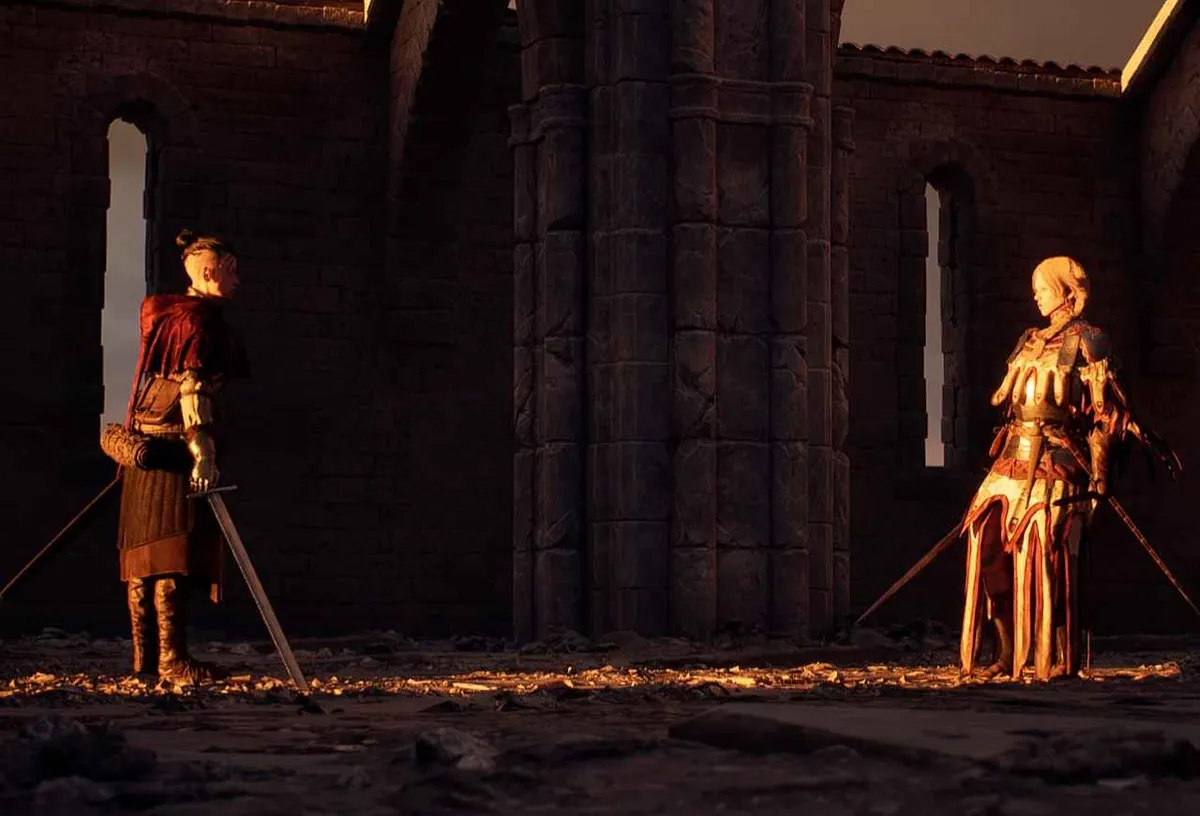
While Bianca comes from nothing, and finds herself forced on the path of the church against her will, Aeta is a child of privilege. She is still a woman (I'd argue Aeta is gender nonconforming but the game does not have time for that discussion), but her family is nobility. Due to this Aeta has been granted certain indulgences by her father (again, without much explanation beyond "it is convenient for the story") including the ability to train and live as a knight errant. Furthermore, Aeta is perceived by nearly everyone she encounters in the world as a man. This affords her privileges in life Bianca sees as unreachable for herself.
It's a version of events that shies away from complexities that naturally arise. No questions about Aeta's own duties and expectations as a woman of noble descent (namely to be married and continue the family line) are ever discussed, conveniently avoiding a reading of her own life as a prisoner. This characterization paints Aeta as naive to the ways of the world.
In many ways Aeta's journey to rescue Bianca, then, should be a wake-up call that sets the stage for her ability to see Bianca's perspective. An early conflict plays out between a lord of a castle that enlists Aeta in eradicating a group of brigands terrorizing the land (which he implies are also Bianca's kidnappers). After cutting down most of these vile intruders, it is revealed to Aeta that they are dissatisfied subjects of the lord, who rather than care for his people when the plague struck decided to hoard food and supplies. This should raise questions in Aeta about the established systems that run her world and the ease with which they can be corrupted. While she does spare the remaining peasants, it is under the threat of death if they do not change their ways. 1348 Ex Voto sees fit to let the lord off without any such warning from Aeta.
Another opportunity for learning comes in the form of a cult of Catholics known as Flagellanti. These heretical and violently misogynistic men see women as the source of evil and, in one of 1348 Ex Voto's climactic moments, attempt to burn Bianca at the stake for her womanhood. Aeta is knocked out while rescuing her from fiery doom; A cut-to-black and sudden timeskip allow the cult to exit the narrative without much in the form of consequence. The game's chosen setting also coincidentally leaves the player with no knowledge that the real group on which these villains are based were officially condemned as heretics in a papal bull issued by Clement VI in 1349.
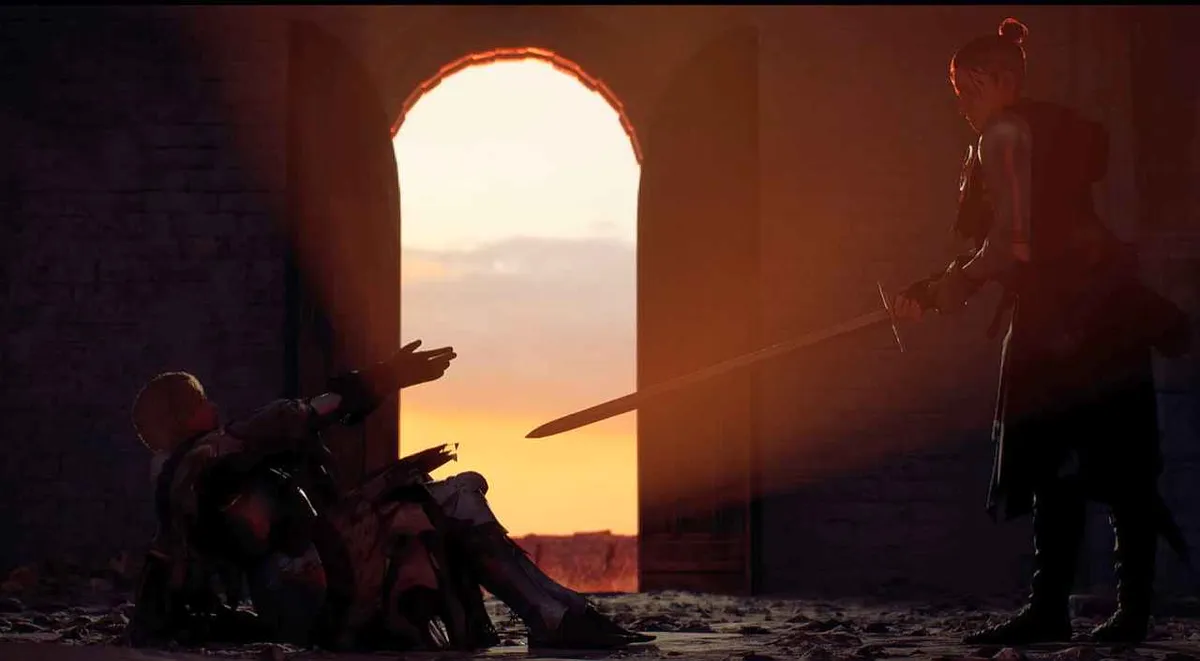
All of this should build to the confrontation between Aeta and Bianca, but 1348 Ex Voto takes a black and white approach to a complex issue. Bianca's violence is seen as unequivocally morally unjust and therefore irredeemable. Despite monologuing her tragic backstory and reasoning for minutes on end at the game's conclusion, it is all portrayed as the musings of a madwoman. Aeta is no longer a knight in the romantic sense —someone meant to pine for and rescue a damsel— but in the enforcement sense –a figure meant to defend institutional status quo under threat of violence. Aeta must dispatch Bianca as she threatens the accepted systems of the world. She does not see it this way, however, but rather as a necessity, "so no more innocents will suffer." This declaration willingly ignores the very real suffering of Bianca.
Bianca and Aeta's identities exist within a hierarchy. Most importantly, class; Aeta is first and foremost a noble and Bianca a peasant. Next, the identities of knight errant and postulant, respectively. Thirdly the shared identity of womanhood (again, we shall not dig into Aeta's whole gender deal). Lastly on the hierarchical ladder are the pair's identities as queer women. 1348 Ex Voto does not value the queer experience of either character enough to believe that it can outweigh any obligations their respective classes demand of them.
Aeta is our hero because she understands her place. Bianca's drive to break out of her lot in life is what makes her the irredeemable villain. Despite constantly showing why Bianca would choose to fight for her own future at the cost of burning everything down around her, the game seeks to end any argument with the gotcha that she is now a mass murderer. It is unearned and feels more like a Band-Aid meant to cover up a glaring flaw in the narrative's own logic. "I hear your pain," says Aeta in the midst of their deadly dance, "but…"
It is that "but" that defines 1348 Ex Voto's diminishing of its own story of queerness. There is never an acknowledgement of Bianca's tragedy that comes unvarnished by further qualifications or admonishments. Bianca, like Aeta, should have been content with letting her queerness be an afterthought in her life. Because she does not, Bianca becomes the character the game is willing to punish the most. 1348 Ex Voto takes everything from Bianca, even in death she is not given the dignity to die as the woman she fought to become. Rather she must revert back to a figure more befitting an Arthurian tale. She is the damsel. She must be saved. Aeta, with a final thrust of the sword, does what any good knight would.
1348 Ex Voto is out now on Windows PC and PS5. The game was played on PC using a prerelease download code provided by the publisher.
You can hear my extensive thoughts on 1348 Ex Voto, beyond just its ending, in Episode 164 of Girl Mode.
Here are games I recommend if you are interested in 1348 Ex Voto but I've convinced you not to play it:
- Signalis: Doomed yuri done well
- Indika: Dealing with religious trauma
- Misericorde: Queer nuns
- Hellblade(just the first one): Grief, trauma, a woman with a sword
If you liked this piece then you can tell me on Bluesky. You can also send some money my way via PayPal